Friday, August 14, 2015

Garden Variety Bat Man

Greetings Wild Indigo readers! Its Friday and another weekend is upon us and another work week behind us.  But for avid gardeners like ourselves our work in the garden is never done! If you're like me you'd might as well have the Cannon Power Shot glued to your hoe since the best shots of nature are unexpectedly spontaneous.  Now I've been putting off for weeks my basil series namely due to the fact that there have been so many other pop up events and critters occupying blog space. This week's photos are no exception as we explore a "black and yellow" themed blog so on we go.

Enter exhibit A: spidy and baby.  Commonly known as Yellow Garden Spider, Argiope Aurantia are a distinctive "garden variety" arachnid as noted by their golden and black abdominal markings. The name means "gilded silver face" from which nature has provided not one, not two but eight eyes to meet their visual needs. This gal has her web cast between the fennel stems. There's a section in the middle of the web with a thick zig zag stitch (I doubt any sewing machine could stich one like it) called stabilimentum where she tends to hang out. Notice her young-in by her side. She encased a brown wasp with mercury man speed as baby takes the apprenticeship role, observing momma in action. (baby's notepad and pencil not photographed)

Ain't no itsy bitsy Argiope Aurantia. That's MRS to you young lady!

Admittedly this next photo is blurry but functional. I've been trying all summer long to get a shot of both the male and female Eastern Golden Finchs together but since he stood out against the flowers this photo was the easier of the two.  There seem to be two pairs of male-female golden finches enjoying the zinnia flowers both in the front and in the rear gardens.  They are territorial as one male chases after the other as well as his female mate from the flower beds.  They'll be heading to Mexico on their migratory vacation soon but we'll have those zinnias ready for next years buffet!


It's amazing how insects can take a licking and keep on ticking.  This poor yellow tailed swallow (minus the yellow tail) has sustained substantial damage yet it just fluttered amongst the zinnias like it owned the joint.


Enter exhibit B: Moon and Stars Heirloom Watermelon.  Now this is my first attempt at growing watermelon and oh what a beauty this one turned out to be! Before cutting it from the Mothervine I noticed another growing nearly adjacent to the large one and snapped a quick shot.  I particularly enjoy the yellow speckles distributed on both the leaves and fruit. 


After weighing this puppy on the digital scale I was pleasantly surprised to find it weighed a modest 17 smackers.  Not bad for my first watermelon. Oh but wait until you see the inside!


Lovely flesh you have there, daaarling!


What impressed me most about this luscious morsel wasn't just its delicious sweet flavor or the one-of-a-kind yellow interior, not even the refreshing juice dripping from my chin but .....

Before storming the castle

.... the seeds! See ... hardly any to speak of and if you look closely the seeds have a black tip so yes folks even the seeds were pure novelty specimens.


After storming the castle

I've never even seen a yellow watermelon let alone grown one so for me - and you're talking to a girl who can't for the LIFE of her grow a freakin tomato  - this was the summer's Celtic Garden First Prize blue ribbon trophy, hands down.

That's it for this weeks installment.  Catch me at the City Market this weekend for some soaps and sundries.

And as always may happiness be like a ray of sunshine in your mind, body and soul. : )
 

Tuesday, August 4, 2015

Nectar of the Gods

Greetings Wild Indigo readers! Last week was pretty crazy so in lieu of the missing post last week my focus this week will be heavy on info with pictures as the highlight. August has arrived and with it comes some lovely flowers which have just bloomed in the Celtic Gardens.  Now hard core gardeners are always keeping their eyes peeled for curious and unusual botanical additions.  Most of the time road trips to Big Bloomers in Sanford are in order for such pleasantries. But for this gardener all I have to do is periodically check in down at the City Market on Saturdays to see what exotic offerings LITFM has for sale. This week's post will focus on the recently purchased Red Asclepias Tuberosa. That's right folks, I said RED!

Asclepias is the genus name for all milkweeds and is derived from the ancient Greek physician Aesculapius and refers to the medicinal properties of the roots. Asclepias extract is an ingredient in medicines used to treat asthma, dyspepsia, and coughs. American Indians used cooked milkweed for food and medicine. Unopened flowers, immature seed pods, and young shoots may be boiled in several changes of salted water. When served with butter, they resemble asparagus.

Milkweed, in particular the orange flowered species, tends to be a native local variety.  Common milkweed was also called wild cotton, Virginia silk, and silkweed. These old names elude to the many utilitarian uses people have discovered for the fluffy contents of the seed pods. The early settlers stuffed mattresses and pillows with it and during World Wars I and II the downy filling went into life preservers and flight jackets. Also known as Butterfly weed and chigger plant, milkweed is a perennial in this locality and is considered to be a wildflower as well. 

If you ever saw photos of the seed pods you can well understand why "weed" is part of its name for its silky hairs could carry the attached seeds for miles on a windy day. The process of pollination to grow these seeds is pretty tricky. According to the Penn State College of Agricultural Sciences, milkweed flowers are hermaphroditic (they have male and female parts) but they require cross-pollination by insects to form seeds.  Enter the pollinators into the equation. The sweet nectar of the Gods from the flowers attracts bees, wasps and flying insects. They enter the crown of the flower and walk along the petals toward the food source. Their feet slip between the petals into a narrow opening where pollinia are hidden. Pollinium are horseshoe shaped with a tiny pollen sack attached to each end and a u-shaped handle in between. (kinda reminds me of a Michael Kors handbag but whatever!) The insect hooks its leg onto the handle thereby dislodging the pollinium and carries it to another flower. When it lands the insect again slips its feet into the narrow opening, but this time when it pulls its leg free the pollinium comes loose and sticks onto the stigma of the female flower part. Viola! Pollination achieved! One to five flowers from each umbel become fertilized and produce a seed follicle. This fleshy and pale green pod is covered with soft-pointed bumps. The follicles grow to 5 inches long and 1½ inch (4 cm) wide, drying and turning brown when the seeds mature in late summer and fall. Then the pod splits lengthwise, releasing the flat brown seeds. Each seed has a tuft of silky hair (pappus) attached and is easily carried aloft by the wind. And now, thanks to the fine people at Penn State for their information, we come full circle.

Where O Where are the dubious Monarch Butterflies? Seriously, it's been years since I've laid eyes on a single one.  Years ago while visiting Maui, Monarch butterflies were strikingly plentiful, adding to the mystic of the islands. But now, at least here in Fayetteville, to me they are just a fond memory. The dwindling  Monarch Butterfly population may be due in part to modern American farming practices, namely the use of glyphosate herbicides. (BTW: ordinary household Roundup Weed Killer contains this ingredient) This broad based weed killer used especially in corn fields where milkweed is a common accompaniment effectively kills weeds in the field to include the Monarch's preferred habitat, milkweed.  Now as stated earlier, milkweed can make a pest of itself in a farmer's field. But said weed control has drastically cut down the habitat of these beautiful insects.

The King of the Butterfly needs a surge in plants which support their natural habitat to encourage their migration. Informative sites like this one give great tips to help restore monarch habitation and encourage Monarch migration back to its hay day. And be sure that you don't mistake this caterpillar for a pest! : )

Now getting back to the cautionary sides of growing common milkweed plants. When any part of the plant is broken a sticky white sap oozes from the wound. This sap can cause a red itchy rash and if it gets into the eye can cause significant cornea inflammation so its best to wear gloves during handling and pruning while being mindful to keep the gloves away from your face. If some suspected sap gets on your hands then promptly wash them with soapy water. Common milkweed (Asclepias Syriaca) contains cardenolide which is chemical steroid and a cardiac arrester. Concentrations of this chemical vary from one milkweed species to another. But Monarchs use this chemical to their advantage for as they consume milkweed leaves this chemical builds up in their bodies and makes them toxic to predators. So if a bird ate a Monarch butterfly or caterpillar it would throw up. How brilliant!! But considering its usefulness the Celtic Garden is quite pleased to call this plant a staple despite its potential danger but more on that in a minute.


So let's unveil the goods, shall we? I love these star-shaped buds and look at that gorgeous red color!


 They're just starting to open up. What a treat!


The plant started from a single stem and is now branching out at the sides.  This plant has a long tap root so when looking for the perfect spot be absolutely sure, for uprooting and moving it to another spot could kill the plant.


That winds up this weeks post. I hope you enjoyed reading through it and tapping into all of the provided links it as much as I enjoyed researching this post. Stay tuned for more wild and wooly Celtic Garden adventures as we begin winding up for our Fall garden while caring for Summer's harvest.

And as always, may happiness be a ray of sunshine in your mind, body and soul.  ; )

Friday, July 24, 2015

Wings -n- Things

Greetings Wild Indigo readers! Its a gorgeous day here in the 'Ville with sunshine and less humidity. Although the sun is getting lazier these days produce is plentiful and dare I say at it's peak! The local farmers markets are overflowing with seasonal offerings many of which are at their height of plenty so be sure to scope out a farmers market near you and indulge in the goodness!

So once again as the post title gives it away, we've got more garden insects in store this week.  As promised I nabbed a photo of the cocoon of a Eastern Black Swallowtail but first things first.

While at a local family owned nursery I spied this little one hovering shamelessly on a stand of fuchsia petunias.  This is not a hummingbird but one of sorts.  This is a hummingbird moth, commonly mistaken for a hummingbird for obvious reasons.  But if you looked closely you'd see why it resembles a hummingbird and also why it certainly does not. It does hover and drink nectar in the same fashion as hummingbirds do but with close inspection one can see the marked differences, namely just that - the markings.  Plus the body size differs as these guys are - excuse me for saying - a bit "chubbier."
   

So its hard to believe that a creature that looks like this .....


..... Morphs into this! Yep I found an Eastern Black Swallowtail cocoon on my fennel! Now I remember doing a "book report" 'cause back in the day BEFORE the internets reference materials were published in book/encyclopedia format detailing the life cycle of butterflies. To this day they still fascinate me, as you can see.  I love how it suspends itself by the silky parachute chysalis which in basic terms is its dead skin.  Still a marvel to look at, I must say.


Now this is a yellow swallowtail who graced its presence a few days ago and was quite willing to let me photograph its beauty. I'll let the pictures speak for themselves. 


I hope you enjoyed this all be it short yet fluttery blog this week but now I must sciddaddle outta here!

As always may happiness be a ray of sunshine in your mind, body and soul.  : )

Friday, July 17, 2015

Critters, Creepers and Crawlers

Greetings Wild Indigo readers! Its FRIDAY!!! Whooo Hooo!! I'm so excited to share this weeks blog with you. After serious deliberation on this week's content these garden friends made the final cut so hold on to your seat as we explore the critters, creepers and crawling inhabitants of Celtic Garden!


First up is this squirrely  individual.  With all of the rain we've had this summer you'd think that I had a mushroom farm here at the Celtic Gardens! We have these ginormous white mushrooms out front that garden fairies would fight over. Well I snapped this shot of this little guy munching away at one.  Heck, I didn't even know squirrels ate such vegetation.


Dragonflies are a common sight in the garden.  According to Smithsonian, there's over 5,000 species all belonging to the Odonata order which means "toothed one" in Greek, referring to the serrated teeth of dragonflies.  Now the following information reads much like a cheap low-budget film in the making, so here we go. There's two stages in the life of a dragonfly.  In their larval stage which can last over two years dragonflies are aquatic beings. They eat tadpoles, mosquitoes, fish other insect larvae and even other dragonfly larvae.  At the end of its larval stage the dragonfly crawls out of the water. Its exoskeleton cracks open and releases the insect's abdomen that's been packed into the shell much like a telescope.  Its four wings are released and dry off. (Cue the epic music and fog machine please and roll the cameras!) The head of a dragonfly is pretty much its eye so their vision is nearly panoramic.  Adult dragonflies are beneficial in the garden for mosquito control which is their mainstay.  

The first individual - Goldie - was hastily shot from the deck as it calmly perched on the Japanese Persimmon. See it on the left?


The second individual kept me company whilst picking blueberries out in the countryside of Stedman. This one had it's own zip code, I do believe.  What really interests me about animals as well as insects is their ability to engage you with their eyes.  I mean they look you eye to eye.  Really amazing, me thinks.


So in the next series we're featuring the life cycle of the Eastern Black Swallowtail.   Butterflies invoke a certain joy and happiness reminiscent of my girlhood days of old. Although I have yet to see a Monarch butterfly this year Eastern Black Swallowtails repeatedly make their presence and home at Celtic Gardens.  

The story begins with a single female. She hovered at the fennel and laid her eggs in the newly formed bloom.  


In a few days the eggs hatched.  The larvae had an instant food source and they found nourishment from the tender growth of newly formed sprigs.


When the eggs hatch the larvae are very small.  These pictures were from larvae from earlier this summer. The female also chooses dill and carrot leaves as suitable homes for her eggs.


This is what the actual caterpillar looks like in a few weeks. As the plant is consumed its growth is rapidly gained. 


I have yet to find a cocoon but as I'm hunting for them when i find one I'll post the picture.  Some gardners like me purposely plant herbs like fennel, parsley and dill to support butterfly habitat.  Again carrot greens are another favorite so consider including a few extra plants dedicated to supporting their needs.  You'll be rewarded with their presence and company in your garden. 

That concludes this weeks creepy crawly installation.  Bug spray not included but will be sold at this weeks City Farmers Market. (shameless plug? You betcha!)

And as always may happiness be a ray of sunshine in your mind, body and soul!

Baby Mantis blog bomb!

Friday, July 10, 2015

In the PINK!

Greetings Wild Indigo readers! The dog days of summer have officially begun although we were feelin the heat long before July rolled in. Rain may be on the way but so far this week we've had less than an inch to speak of.  So hand watering has begun as well as utilizing the irrigation system installed back in May. Despite a few fainting zinnias out front the Celtic Garden remains green and vibrant.  In fact, we're in the PINK!  : )

Cypress Vines grow perennially in our area. Its a species of Ipomoea Quamoclit morning glory - say THAT ten times fast, I dare ya! - which is native in tropical regions to include South America, North Mexico and even Bangladesh. This herbaceous plant is a fast growing twining vine reaching up to 10 feet in a season so it can be invasive unless controlled. I planted mine in a 1 gallon pot with a tomato cage for its trellis.  As you can see the bright red trumpet flowers, though small, pack a punch of color against the feathery foliage. (lower left) This one survived last year's frosty winter in a 3" pot outside.  When growth began a month or so ago I transplanted it as well as another seedling which had sprouted in another pot out on the deck. To the right of the Cypress Vine a cheerful cluster of Coral Honeysuckle Vine (Lonicera Sempervirens sp.) continues the whimsical pink theme.  The color of the Coral Honeysuckle starts pink at the stem then gradually changes into its name's sake. The inside is a true coral hue reminiscent of conch shells found at the beach.


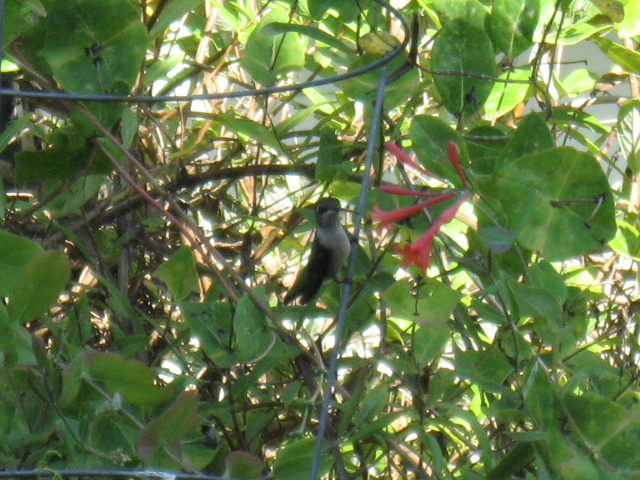
 Both plants are hummingbird magnets as documented in the following photos.


Ain't this a Sweetheart of a hummer! Now this little one is a very young looking at the size of it compared to other hummingbirds which come and visit the same coral honeysuckle vine.  Its tiny but not a baby since baby hummingbirds can't fly.  Most hummingbirds in my area are of the Ruby-Red Throat variety. Identifying the sex of this bird is a quilled quandary query!  Young males masquerade as females up until a year after birth when their red feathers around the front of their necks begin growing in. So for now I'll name this one the neutral gendered name Sweetheart since that's precisely what it is.


I've seen hummingbirds zone in for the Lantana for nectar, too.  This pink and yellow one lives in the back edges of the property near the Dogwood tree.  Lantana falls within the verbena family which covers over 150 species, of which at least four varieties that call the Celtic Garden their home. Australians consider this plant a noxious weed but here in the Carolina's they grow as shrubs four to five feet tall in full sun with well drained soil.  When trimming back this shrub in the spring it smells of mint but nevertheless Lantana is not in the Lamiaceae family.


Zinnias are a favorite flower of Celtic Gardens since they are crazy easy to grow and love the sun. Not only that but they come in such a wide variety of colors from neon green to peppermint candy speckled flowers as well as the traditional orange, white and pink varieties.  Every winter while drooling through seed catalogs new varieties are always added to the "must have" list. Most varieties are "cut and come again" so frequent pruning ensures healthy plants and bountiful flowers.  If you're lucky you might catch me selling fresh cut bouquets at the farmers market.If you don't get a chance to cut back the flowers don't fret - the birds love the seeds which is a win-win since they sow next year's flower bed for free!


Dianthus are also a low maintance flowering plant that come in a multitude of colors.  These magenta ones brighten up the serpentine shade garden, off setting the white and greenery backdrop quite nicely.
Dianthus is a genus of over 300 species.  Maybe you've heard of Carnation or Sweet William varieties. They grow best in part shade but do enjoy a few hours of direct sunlight. Their fringed petals add yet more garden whimsy and texture especially strewn amongst inpatients. 


That does it for this weeks entry.  For note: in a few weeks Sunshine Soaps will have three batches of cured Patchouli, Chocolate Mint and Lavender Vanilla soap available for sale at the City Market. Depending on today's product delivery another batch of organic bug spray will also be available sooner rather than later.

Thanks for reading and as always may happiness be rays of sunshine in your mind, body and soul!


Monday, June 29, 2015

UBER Dropplets!

Greetings Wild Indigo readers! The Celtic Gardens are greener than ever with the whopping 2"+ rainfall we've had this weekend so once again many thanks to mother Nature for her showers of blessings! Seriously, the rain barrels are once again full and the bird bath graciously held out its Celtic arms and is at maximum capacity. The bird bath is at the center piece of the Celtic Garden for a reason: its kinda like having a pool in one's back yard - all the neighbors want to come swim! Its an eye catching garden feature but also serves as a major water and bathing source for our feathery friends. Plus it provides beaucoup tweety bird entertainment! Speaking of tweety birds, a pair of yellow finches were recently sighted accompanied oddly enough by a female hummingbird. They enjoy grazing in the zinnia, drinking from the bouquets and feasting on seeds.  These beautiful yellow and black birds are familiar Celtic Garden friends and their return is an auspicious homecoming!  Hopefully I'll get a picture of them since they are so captivating.
  
While planning our gardens sometimes we achieve undesirable results. Recently the Celtic Gardens received a much needed mulching. As all gardeners know, mulching provides as both a weed barrier as well as moisture retention which in addition to its clean look is a win-win all around.  Research and choose wisely for the kind most suited for your Xeriscaping needs. As for me, I choose a compost mulch that biodegrades well for soil amendment. However prior proper planning should be utilized, specifically in regard to drainage. Mulch was applied to the new serpentine shade bed and wild indigo crescent bed. During the mulching madness application, drainage troubleshooting was discussed. But we went ahead with the plan.  Friday evening's thunder storms were a sure test. After scouting this area from the deck during the storm, flooding indeed ensued to include the entire area beyond the wild indigo bed, surrounding the Japanese Persimmon tree and flooding clean down to the garden gate. The torrent of rain streaming off the roof line took the usual run off path along the foundation under the deck into the garden and/or driveway but was greatly impeded - by a bunch of horse poop! So this week's task will be to install the suggested pea gravel along the roof line and spread the excess mulch to other areas after flooding necessitated the immediate manual removal during the storms. Yea we're still drying out!

Despite the live and learn mulching event a personal gardening victory has been achieved!  Up until this point the elusive lupine has escaped the Celtic Garden.  Many plants have been tried and much investment has been made into plants that failed to thrive. Various locals were tried throughout the garden but to no avail. Until this little number came into the picture.  May we present: Wild Lupine! Many thanks to LITFM for sharing seeds and as you can see successful germination has taken place! YIPEEEE!!


While not yet rated by the motion picture association upon review it may prove risque for I'm sure you'll agree the carpenter bee is having a field day to say the least getting his buzz on in the bee balm crack!


Now these Rudbeckia Hirta Green Eyes were featured in the last post but I simply couldn't help but include their happy shiny faces in this one either. 


Obviously this is a soap making photo bomb! Patchouli you are a free spirit, indeed!


Capping off this weeks blog is a series of sunset photos taken Sunday evening. I'll let Mother Nature speak for herself ~ no words necessary.  : )


And as always may happiness be a ray of sunshine in your mind, body and soul!


UPDATE: Project completed! With a quick jaunt over to the local Lowes pea gravel was procured. The unruly mulch was raked into other garden spots freeing up the run off path. Now that the gravel is down hopefully this will solve the issue. 


Friday, June 19, 2015

A Drink of Cool Cool Rain

Greetings wild indigo readers! How be ye? Well we at the Celtic Gardens are thrilled with the recent rains Mother Nature has poured down upon us ~ to the tune of 2.5" in the last 48 hours! To celebrate here's a little Who's Who of thanks: https://www.youtube.com/watch?v=gDbAtWpoA6k

So now that the Celtic Gardens have drunk their fill I'd also like to include a link to LITFM blog which details the in's -n- out's regarding Mother Natures load of NITRO energies our neighborhoods with prized copious lavish greenery! Yes, beginning Wednesday night around 10:30 pm on and off through even this morning, all told our locality has received over 2" of rain.  I was so happy to hear the droplets that I even shot a picture as they began filling up the water collection chambers!

Although I'm still tweaking the daisy chain for both rain barrels at this moment they are at full capacity and ready for the next span between storms which I hope won't be too long seeing that we're still in store for another week of heat advisory double digit temps! Drink plenty of liquids and avoid the heat of the day as much as possible peeps! Now on to more pics.

Have I ever made mention that I love the smell of rain? It reminds me of when I was a little girl.  During late night summer rainstorms you could find me kneeling at my bedroom window cuddling my pillow with my nose pressed to the window screen smelling the air and relishing the sound of thunder and streaks of electricity from the storm clouds. There's just something about that combination of rain, thunder and lightning that thrills me.  Maybe its the rawness of nature and her ability to astound through our senses that fuels my tribal rain worship!

So now that the rains have come, look what's bloomed! Now before the unveiling, everyone say *FAIL!* That's because I have a new phone and the picture of the descriptive card is no more BUT I can tell you that this is a rudbeckia that I purchased at - you guessed it - Big Bloomers.

Notice the petal color which is a golden yellow with lighter tips and green eye!
So with a quick dash of the keys and a Google search, it appears this is a Rudbeckia Hirta Green Eye variety. As you can see it grows in containers quite well.  I also have a few strewn in the bird bath bed which are coming along nicely.

This next flower made its grand entrance just shy of this week's rains and certainly is a one of a kind. 
She is a white balloon flower but her more common violet-blue variety gets more fanfare. They've gained popularity as container and rock garden staples. She stands solo but made it through the harsh winter so she's a keeper!
 

You've heard me ramble on about selling items at our local Fayetteville City Market. Well last week I had plucked these beauties from the ground and they were sold at the market lickity split to good homes (and stomachs!)


These guys were direct seeded into the "root bed" back in March whose soil is very loose and well mulched.  Now it took well over 65 days to mature. I attribute their lengthy growing time to the warmer spring temps resulting in warmer soil temps. As we now carrots prefer cooler growing temps so they weren't grown in their preferred environment but still rock! They were about four inches in length at harvest. Thankfully there's still a few left in the field for personal crunching! I haven't grown such lovely carrots in years and they'll definitely be a yearly garden addition.

So I was at our local Target store recently pursuing the aisles when I came across this little number. I was happy to see this brand being offered commercially since "Mortgage Lifter" is an heirloom tomato which I had considered growing way back in February! How cool it is to see this kind of product being made available! Being the diabetes educator and food label reader that I am, I love the "no added sugar" boasting.


As curiosity would have it, research into the saucy mysteries surrounding this savory sampling was clearly in order! Their website is chunk full of neat vignettes and juicy tidbits to include mention of "The Beekman Boys" reality show and their competing in CBS's  The Amazing Race in 2012 of which they won the grand prize. Now according to their website 25% of the profits are donated to help support struggling small American farmers. If their pasta sauce earnings come anywhere close to their revenues from their tv series then I'd say they've made substantial contributions to some lucky small farmers. Although there aren't any details documenting how and whom has received support let's hope their word stands. Their dreams have been materialized and we applaud their efforts as we slurp down our zoodles drenched in their original recipe!

Finally I'm giving homage to the beautiful sunset Saturday June 13th. Summer's official arrival is this Saturday, a most welcomed visitation.  We may complain about the excessive heat but remembering the long winter we had I'll embrace the heat in exchange for gazing upon the Celtic Garden's pleasantries. In case you're living locally I'll be offering soap and sundries Saturday at the market. I've got sunbalm 30 as well as organic bug spray added to the Sonshine Soaps arsenal. In case you're looking for hot peppers or aloes to cool the burn check out my friend Tom's offerings at our Sustainable Neighbor booth.

And as always may happiness be a ray of sunshine to your mind, body and soul!

Peace out!